|
|
Publications
|
Monoxide: Scale out Blockchains with Asynchronous Consensus Zones
Jiaping Wang,
Hao Wang
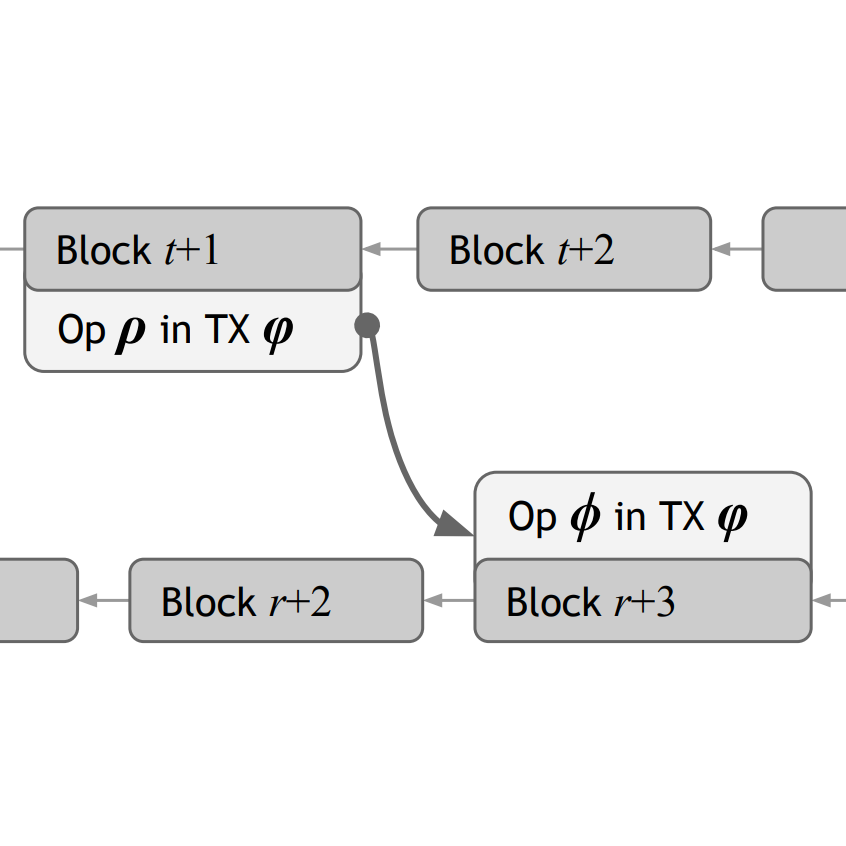
Cryptocurrencies have provided a promising infrastructure for pseudonymous online payments. However, low throughput has significantly hindered the scalability and usability of cryptocurrency systems for increasing numbers of users and transactions. Another obstacle to achieving scalability is that every node is required to duplicate the communication, storage, and state representation of the entire network.
In this paper, we introduce the Asynchronous Consensus Zones, which scales blockchain system linearly without compromising decentralization or security. We achieve this by running multiple independent and parallel instances of single-chain consensus (zones). The consensus happens independently within each zone with minimized communication, which partitions the workload of the entire network and ensures moderate burden for each individual node as network grows. We propose eventual atomicity to ensure transaction atomicity across zones, which guarantees the efficient completion of transaction without the overhead of two-phase commit protocol. We also propose Chu-ko-nu mining to ensure the effective mining power in each zone is at the same level of the entire network, and makes an attack on any individual zone as hard as that on the entire network. Our experimental results show the effectiveness of our work. On a test-bed including 1,200 virtual machines worldwide to support 48,000 nodes, our system deliver 1,000× throughput and 2,000× capacity over Bitcoin and Ethereum network.
NDSI 2019 [ paper ] [ project ] [
bibtex
]
16th USENIX Symposium on Networked Systems Design and Implementation, February 2019, Boston, MA
|
|
Efficient Reflectance Capture Using an Autoencoder
Kaizhang Kang,
Zimin Chen,
Jiaping Wang,
Kun Zhou,
Hongzhi Wu
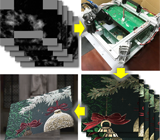
We propose a novel framework that automatically learns the lighting patterns for efficient reflectance acquisition, as well as how to faithfully reconstruct spatially varying anisotropic BRDFs and local frames from measurements under such patterns. The core of our framework is an asymmetric deep autoencoder, consisting of a nonnegative, linear encoder which directly corresponds to the lighting patterns used in physical acquisition, and a stacked, nonlinear decoder which computationally recovers the BRDF information from captured photographs. The autoencoder is trained with a large amount of synthetic reflectance data, and can adapt to various factors, including the geometry of the setup and the properties of appearance. We demonstrate the effectiveness of our framework on a wide range of physical materials, using as few as 16 ~ 32 lighting patterns, which correspond to 12 ~ 25 seconds of acquisition time. We also validate our results with the ground truth data and captured photographs. Our framework is useful for increasing the efficiency in both novel and existing acquisition setups.
ACM SIGGRAPH 2018 [ paper ] [ video ] [ project ] [
bibtex
]
ACM Transactions on Graphics Volume 37, Number 4, August 2018
|

|
Vector Regression Functions for Texture Compression
Ying Song,
Jiaping Wang,
Liyi Wei,
Wencheng Wang
Raster images are the standard format for texture mapping, but they suffer from limited resolution. Vector graphics are resolution-independent but are less general and more difficult to implement on a GPU. We propose a hybrid representation called vector regression functions (VRFs), which compactly approximate any point-sampled image and support GPU texture mapping, including random access and filtering operations. Unlike standard GPU texture compression, (VRFs) provide a variable-rate encoding in which piecewise smooth regions compress to the square root of the original size. Our key idea is to represent images using the multilayer perceptron, allowing general encoding via regression and efficient decoding via a simple GPU pixel shader. We also propose a content-aware spatial partitioning scheme to reduce the complexity of the neural network model. We demonstrate benefits of our method including its quality, size, and runtime speed.
ACM TOG 2015 [ paper ] [
bibtex
]
ACM Transactions on Graphics Volume 35, Number 1, December 2015
|

|
Global Illumination with Radiance Regression Functions
Peiran Ren, Jiaping Wang, Minmin Gong, Stephen Lin, Xin Tong, Baining Guo
We present radiance regression functions for fast rendering of global illumination
in scenes with dynamic local light sources. A radiance regression function (RRF)
represents a non-linear mapping from local and contextual attributes of surface
points, such as position, viewing direction, and lighting condition, to their indirect
illumination values. The RRF is obtained from precomputed shading samples through
regression analysis, which determines a function that best fits the shading data.
For a given scene, the shading samples are precomputed by an offline renderer.
The key idea behind our approach is to exploit
the nonlinear coherence of the indirect illumination data to make the RRF both compact
and fast to evaluate. We model the RRF as a multilayer acyclic feed-forward neural
network, which provides a close functional approximation of the indirect illumination
and can be effi- ciently evaluated at run time. To effectively model scenes with
spatially variant material properties, we utilize an augmented set of attributes
as input to the neural network RRF to reduce the amount of inference that the network
needs to perform. To handle scenes with greater geometric complexity, we partition
the input space of the RRF model and represent the subspaces with separate, smaller
RRFs that can be evaluated more rapidly. As a result, the RRF model scales well
to increasingly complex scene geometry and material variation. Because of its compactness
and ease of evaluation, the RRF model enables real-time rendering with full global
illumination effects, including changing caustics and multiple-bounce high-frequency
glossy interreflections.
ACM SIGGRAPH 2013 [ paper ] [ video ] [
bibtex
]
ACM Transactions on Graphics Volume 32, Number 4, July 2013
|
|
Interactive chromaticity mapping for multispectral images
Yanxiang Lan, Jiaping Wang, Stephen Lin, Minmin Gong, Xin Tong, Baining Guo
Multispectral images record detailed color spectra at each image pixel. To display a multispectral image on conventional output devices, a chromaticity mapping function is needed to map the spectral vector of each pixel to the displayable three dimensional color space. In this paper, we present an interactive method for locally adjusting the chromaticity mapping of a multispectral image. The user specifies edits to the chromaticity mapping via a sparse set of strokes at selected image locations and wavelengths, then our method automatically propagates the edits to the rest of the multispectral image. The key idea of our approach is to factorize the multispectral image into a component that indicates spatial coherence between different pixels, and one that describes spectral coherence between different wavelengths. Based on this factorized representation, a two-step algorithm is developed to efficiently propagate the edits in the spatial and spectral domains separately. The method presented provides photographers with efficient control over color appearance and scene details in a manner not possible with conventional color image editing. We demonstrate the use of interactive chromaticity mapping in the applications of color stylization to emulate the appearance of photographic films, enhancement of image details, and manipulation of different light transport effects.
[ paper ][
bibtex ]
The Visual Computer volume 29, May 2013
|
|
Pocket Reflectometry
Peiran Ren, Jiaping Wang, John Snyder, Xin Tong, Baining Guo
We present a simple, fast solution for reflectance acquisition using tools that
fit into a pocket. Our method captures video of a flat target surface from a fixed
video camera lit by a hand-held, moving, linear light source. After processing,
we obtain an SVBRDF. We introduce a BRDF chart, analogous to a color "checker" chart,
which arranges a set of known-BRDF reference tiles over a small card. A sequence
of light responses from the chart tiles as well as from points on the target is
captured and matched to reconstruct the target's appearance.
We develop a new algorithm for BRDF reconstruction which works directly on these
LDR responses, without knowing the light or camera position, or acquiring HDR lighting.
It compensates for spatial variation caused by the local (finite distance) camera
and light position by warping responses over time to align them to a specular reference.
After alignment, we find an optimal linear combination of the Lambertian and purely
specular reference responses to match each target point's response. The same weights
are then applied to the corresponding (known) reference BRDFs to reconstruct the
target point's BRDF. We extend the basic algorithm to also recover varying surface
normals by adding two spherical caps for diffuse and specular references to the
BRDF chart.
ACM SIGGRAPH 2011 [ paper ] [ video ] [
bibtex ]
ACM Transactions on Graphics Volume 30, Number 4, July 2011
|
|
Condenser-Based Instant Reflectometry
Yanxiang Lan, Yue Dong, Jiaping Wang, Xin Tong, Baining Guo
We present a technique for rapid capture of high quality bidirectional reflection
distribution functions(BRDFs) of surface points. Our method represents the BRDF
at each point by a generalized microfacet model with tabulated normal distribution
function (NDF) and assumes that the BRDF is symmetrical. A compact and light-weight
reflectometry apparatus is developed for capturing reflectance data from each surface
point within one second.
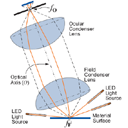
The device consists of a pair of condenser lenses, a video camera, and six LED light
sources. During capture, the reflected rays from a surface point lit by a LED lighting
are refracted by a condenser lenses and efficiently collected by the camera CCD.
Taking advantage of BRDF symmetry, our reflectometry apparatus provides an efficient
optical design to improve the measurement quality. We also propose a model fitting
algorithm for reconstructing the generalized microfacet model from the sparse BRDF
slices captured from a material surface point. Our new algorithm addresses the measurement
errors and generates more accurate results than previous work.
Our technique provides a practical and efficient solution for BRDF acquisition,
especially for materials with anisotropic reflectance. We test the accuracy of our
approach by comparing our results with ground truth. We demonstrate the efficiency
of our reflectometry by measuring materials with different degrees of specularity,
values of Fresnel factor, and angular variation.
Pacific Graphics 2010 [ paper ] [
bibtex ]
Computer Graphics Forum, Volume 29, Number 7, Oct 2010
|

|
Manifold Bootstrapping for SVBRDF Capture
Yue Dong, Jiaping Wang, Xin Tong, John Snyder, Yanxiang Lan, Moshe Ben-Ezra, Baining Guo
Manifold bootstrapping is a new method for data-driven modeling of real-world, spatially-varying
reflectance, based on the idea that reflectance over a given material sample forms
a low-dimensional manifold. It provides a high-resolution result in both the spatial
and angular domains by decomposing reflectance measurement into two lower-dimensional
phases. The first acquires representatives of high angular dimension but sampled
sparsely over the surface, while the second acquires keys of low angular dimension
but sampled densely over the surface.
We develop a hand-held, high-speed BRDF capturing device for phase one measurements.
A condenser-based optical setup collects a dense hemisphere of rays emanating from
a single point on the target sample as it is manually scanned over it, yielding
10 BRDF point measurements per second. Lighting directions from 6 LEDs are applied
at each measurement; these are amplified to a full 4D BRDF using the general (NDF-tabulated)
microfacet model. The second phase captures N=20-200 images of the entire sample
from a fixed view and lit by a varying area source. We show that the resulting N-dimensional
keys capture much of the distance information in the original BRDF space, so that
they effectively discriminate among representatives, though they lack sufficient
angular detail to reconstruct the SVBRDF by themselves. At each surface position,
a local linear combination of a small number of neighboring representatives is computed
to match each key, yielding a highresolution SVBRDF. A quick capture session (10-20
minutes) on simple devices yields results showing sharp and anisotropic specularity
and rich spatial detail.
ACM SIGGRAPH 2010 [ paper ] [ video ] [
bibtex ]
ACM Transactions on Graphics Volume 29, Number 4, July 2010
|
|
Fabricating Spatially-Varying Subsurface Scattering
Yue Dong, Jiaping Wang,
Fabio Pellacini, Xin Tong, Baining Guo
Many real world surfaces exhibit translucent appearance due to subsurface scattering.
Although various methods exists to measure, edit and render subsurface scattering
effects, no solution exists for manufacturing physical objects with desired translucent
appearance. In this paper, we present a complete solution for fabricating a material
volume with a desired surface BSSRDF. We stack layers from a fixed set of manufacturing
materials whose thickness is varied spatially to reproduce the heterogeneity of
the input BSSRDF. Given an input BSSRDF and the optical properties of the manufacturing
materials, our system efficiently determines the optimal order and thickness of
the layers. We demonstrate our approach
by printing a variety of homogenous and heterogenous BSSRDFs using two hardware
setups: a milling machine and a 3D printer.
ACM SIGGRAPH 2010 [ paper ] [ video ] [
bibtex ]
ACM Transactions on Graphics Volume 29, Number 4, July 2010
|
|
Real-time Rendering of Heterogeneous Translucent Objects
with Arbitrary Shapes
Yajun Wang, Jiaping Wang,
Nicolas Holzschuch,
Kartic Subr,
Jun-Hai
Yong, Baining
Guo
We present a real-time algorithm for rendering translucent objects of arbitrary
shapes. We approximate the scattering
of light inside the objects using the diffusion equation, which we solve on-the-fly
using the GPU. Our algorithm is general enough to handle arbitrary geometry, heterogeneous
materials, deformable objects and modifications of lighting, all in real-time. In
a pre-processing step, we discretize the object into a regular 4-connected structure
(QuadGraph). Due to its regular connectivity, this structure is easily packed into
a texture and stored on the GPU. At runtime, we use the QuadGraph stored on the
GPU to solve the diffusion equation, in real-time, taking into account the varying
input conditions: Incoming light, object material and geometry. We handle deformable
objects, provided the deformation does not change the topological structure of the
objects.
Eurographics 2010 [ paper ] [ video ] [ bibtex ]
Computer Graphics Forum, Volume 29, Number 2, May 2010
|
|
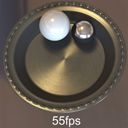
All-Frequency Rendering of Dynamic, Spatially-Varying Reflectance
Jiaping Wang, Peiran Ren, Minmin Gong, John Snyder, Baining Guo
We describe a technique for real-time rendering of dynamic, spatially-varying BRDFs
in static scenes with all-frequency shadows from environmental and point lights.
The 6D SVBRDF is represented with a general microfacet model and spherical lobes
fit to its 4D spatially-varying normal distribution function (SVNDF). A sum of spherical
Gaussians (SGs) provides an accurate approximation with a small number of lobes.
Parametric BRDFs are fit on-the-fly using simple analytic expressions; measured
BRDFs are fit as a preprocess using nonlinear optimization. Our BRDF representation
is compact, allows detailed textures, is closed under products and rotations, and
supports reflectance of arbitrarily high specularity. At run-time, SGs representing
the NDF are warped to align the half-angle vector to the lighting direction and
multiplied by the microfacet shadowing and Fresnel factors. This yields the relevant
2D view slice on-the-fly at each pixel, still represented in the SG basis. We account
for macro-scale shadowing using a new, nonlinear visibility representation based
on spherical signed distance functions (SSDFs). SSDFs allow per-pixel interpolation
of high-frequency visibility without ghosting and can be multiplied by the BRDF
and lighting efficiently on the GPU.
Proceedings of ACM SIGGRAPH Asia 2009 [ paper ] [ video ] [ bibtex ]
ACM Transactions on Graphics,
Volume 28, Number 5, Aug 2009
|
|
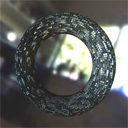
The Dual-microfacet Model for Capturing Thin Transparent Slabs
Qiang Dai, Jiaping Wang,
Yiming Liu, John Snyder, Enhua Wu, Baining Guo
We present a new model, called the dual-microfacet, for those materials such as
paper and plastic formed by a thin, transparent slab lying between two surfaces
of spatially varying roughness. Light transmission through the slab is represented
by a microfacet-based BTDF which tabulates the microfacet’s normal distribution
(NDF) as a function of surface location. Though the material is bounded by two surfaces
of different roughness, we approximate light transmission through it by a virtual
slab determined by a single spatially-varying NDF. This enables efficient capturing
of spatially variant transparent slices. We describe a device for measuring this
model over a flat sample by shining light from a CRT behind it and capturing a sequence
of images from a single view. Our method captures both angular and spatial variation
in the BTDF and provides a good match to measured materials.
Proceedings of Pacific Graphics 2009, Distinguished Paper Award [ paper ] [ bibtex ]
Computer Graphics Forum, Volume 27, Number 3
|
|
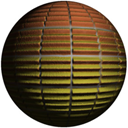
Edit Propagation on Bidirectional Texture Functions
Kun Xu ,
Jiaping Wang, Xin Tong,
Shi-Min Hu,
Baining Guo
We propose an efficient method for editing bidirectional texture functions (BTFs)
based on edit propagation scheme. In our approach, users specify sparse edits on
a certain slice of BTF. An edit propagation scheme is then applied to propagate
edits to the whole BTF data. The consistency of the BTF data is maintained by propagating
similar edits to points with similar underlying geometry/reflectance. For this purpose,
we propose to use view independent features including normals and re?ectance features
reconstructed from each view to guide the propagation process. We also propose an
adaptive sampling scheme for speeding up the propagation process. Since our method
needn’t any accurate geometry and re?ectance information, it allows users to edit
complex BTFs with interactive feedback.
Proceedings of Pacific Graphics 2009 [ paper ] [ bibtex ]
Computer Graphics Forum, Volume 27, Number 3
|

|
Texture Splicing
Yiming Liu, Jiaping Wang, Su Xue,
Xin Tong,
Sing Bing
Kang, Baining
Guo
We propose a new texture editing operation called texture splicing. For this operation,
we regard a texture as having repetitive elements (textons) seamlessly distributed
in a particular pattern. Taking two textures as input, texture splicing generates
a new texture by selecting the texton appearance from one texture and distribution
from the other. Texture splicing involves self-similarity search to extract the
distribution, distribution warping, contextdependent warping, and finally, texture
refinement to preserve overall appearance. We show a variety of results to illustrate
this operation.
Proceedings of Pacific Graphics 2009 [ paper ] [ video ] [ bibtex ]
Computer Graphics Forum, Volume 27, Number 3
|

|
Kernel Nyström Method for Light Transport
Jiaping Wang, Yue Dong, Xin Tong,
Zhouchen Lin,
Baining Guo
We propose a kernel Nystrom method for reconstructing the light transport matrix
from a relatively small number of acquired images. Our work is based on the generalized
Nystrom method for low rank matrices. We introduce the light transport kernel and
incorporate it into the Nystrom method to exploit the nonlinear coherence of the
light transport matrix. We also develop an adaptive scheme for efficiently capturing
the sparsely sampled images from the scene. Our experiments indicate that the kernel
Nystrom method can achieve good reconstruction of the light transport matrix with
a few hundred images and produce high quality relighting results. The kernel Nystrom
method is effective for modeling scenes with complex lighting effects and occlusions
which have been challenging for existing techniques.
Proceedings of ACM SIGGRAPH 2009 [ paper ] [ video ] [ bibtex ]
ACM Transactions on Graphics, Volume 28, Number 3, Aug 2009.
|

|
Modeling Anisotropic Surface Reflectance with Example-based Microfacet
Synthesis
Jiaping Wang, Shuang Zhao, Xin Tong, John Snyder, Baining Guo
We present a new technique for the visual modeling of spatially varying anisotropic
reflectance using data captured from a single view. Reflectance is represented using
a microfacet-based BRDF which tabulates the facets' normal distribution (NDF) as
a function of surface location. Data from a single view provides a 2D slice of the
4D BRDF at each surface point from which we fit a partial NDF. The fitted NDF is
partial because the single view direction coupled with the set of light directions
covers only a portion of the "half-angle" hemisphere. We complete the
NDF at each point by applying a novel variant of texture synthesis using similar,
overlapping partial NDFs from other points. Our similarity measure allows azimuthal
rotation of partial NDFs, under the assumption that reflectance is spatially redundant
but the local frame may be arbitrarily oriented. Our system includes a simple acquisition
device that collects images over a 2D set of light directions by scanning a linear
array of LEDs over a flat sample. Results demonstrate that our approach preserves
spatial and directional BRDF details and generates a visually compelling match to
measured materials.
Proceedings of ACM SIGGRAPH 2008 [ paper ] [ video ] [ bibtex ] [ Reflectance Data ]
ACM Transactions on Graphics, Volume 27, Number 3, Aug 2008.
|
|
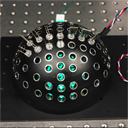
An LED-only BRDF Measurement Device
Moshe Ben-Ezra, Jiaping Wang, Bennett Wilburn, Xiaoyang Li and Le Ma
Light Emitting Diodes (LEDs) can be used as light detectors and as light emitters.
In this paper, we present a novel BRDF measurement device consisting exclusively
of LEDs. Our design can acquire BRDFs over a full hemisphere, or even a full sphere
(for the bidirectional transmittance distribution function BTDF) , and can also
measure a (partial) multi-spectral BRDF. Because we use no cameras, projectors,
or even mirrors, our design does not suffer from occlusion problems. It is fast,
significantly simpler, and more compact than existing BRDF measurement designs.
Computer Vision and Pattern Recognition (CVPR), June 2008. [ paper ] [ bibtex ]
|

|
Image-based Material Weathering
Su Xue, Jiaping Wang, Xin Tong,
Qionghai Dai, Baining Guo
We present a technique for modeling and editing the weathering effects of an object
in a single image with appearance manifolds. In our approach, we formulate the input
image as the product of reflectance and illuminance. An iterative method is then
developed to construct the appearance manifold in color space (i.e., Lab space)
for modeling the reflectance variations caused by weathering. Based on the appearance
manifold, we propose a statistical method to robustly decompose reflectance and
illuminance for each pixel. For editing, we introduce a "pixel-walking"
scheme to modify the pixel reflectance according to its position on the manifold,
by which the detailed reflectance variations are well preserved. We illustrate our
technique in various applications, including weathering transfer between two images
that is first enabled by our technique.
Eurographics 2008 [ paper ] [ video ] [ bibtex ]
Computer Graphics Forum Volume 27 Issue 2, Apr 2008.
|
|
Modeling and Rendering Heterogeneous Translucent Materials using
Diffusion Equation
Jiaping Wang, Shuang Zhao, Xin Tong, Stephen Lin, Zhouchen Lin, Yue
Dong, Baining
Guo, Heung-Yeung
Shum
We propose techniques for modeling and rendering of heterogeneous translucent materials
that enable acquisition from measured samples, interactive editing of material attributes,
and real-time rendering. The materials are assumed to be optically dense such that
multiple scattering can be approximated by a diffusion process described by the
diffusion equation. For modeling heterogeneous materials, we present an algorithm
for acquiring material properties from appearance measurements by solving an inverse
diffusion problem. Our modeling algorithm incorporates a regularizer to handle the
ill-conditioned inverse problem, an adjoint method to dramatically reduce the computational
cost, and a hierarchical GPU implementation for further speedup. To display an object
with known material properties, we present an algorithm that performs rendering
by solving the diffusion equation with the boundary condition defined by the given
illumination environment. This algorithm is centered around object representation
by a polygrid, a grid with regular connectivity and an
irregular shape, which facilitates the solution of the diffusion equation in arbitrary
volumes. Because of the regular connectivity, our rendering algorithm can be implemented
on the GPU for real-time performance. We demonstrate our techniques by capturing
materials from physical samples and performing real-time rendering and editing with
these materials.
ACM Transaction on Graphics, Vol.27, Issue 1, 2008. (ACM SIGGRAPH 2007 Referred
to) [
paper ] [ video ] [ bibtex ]
|
|
Spherical Harmonics Scaling
Jiaping Wang, Kun Xu, Kun Zhou, Stephen Lin, Shimin Hu, Baining Guo
We present an new SH operation, called spherical harmonics scaling,
to shrink or expand a spherical function in frequency domain. We show that this
problem can be elegantly formulated as a linear transformation of SH projections,
which is efficient to compute and easy to implement on a GPU. Spherical harmonics
scaling is particularly useful for extrapolating visibility and radiance functions
at a sample point to points closer to or farther from an occluder or light source.
With SH scaling, we present applications to lowfrequency shadowing for general deformable
object, and to efficient approximation of spherical irradiance functions within
a mid-range illumination environment.
Pacific Conference on Computer Graphics and Applications, Oct 2006. [ paper ] [ video ] [ bibtex ]
The Visual Computer, Volume 22, Sept 2006.
|
|
Appearance Manifolds for Modeling Time-Variant Appearance of Materials
Jiaping Wang, Xin Tong, Stephen Lin, Minghao Pan, Chao Wang, Hujun Bao, Baining Guo and Heung-Yeung Shum
We present a visual simulation technique called appearance manifolds
for modeling the time-variant surface appearance of a material from data captured
at a single instant in time. In modeling timevariant appearance, our method takes
advantage of the key observation that concurrent variations in appearance over a
surface represent different degrees of weathering. By reorganizing these various
appearances in a manner that reveals their relative order with respect to weathering
degree, our method infers spatial and temporal appearance properties of the material’s
weathering process that can be used to convincingly generate its weathered appearance
at different points in time. Results with natural non-linear reflectance variations
are demonstrated in applications such as visual simulation of weathering on 3D models,
increasing and decreasing the weathering of real objects, and material transfer
with weathering effects.
Proceedings of ACM SIGGRAPH, Aug 2006. [ paper ] [ video ] [ slides ] [ bibtex ]
ACM Transactions on Graphics, Volume25, Issue 3, July 2006.
|
|
Capturing and Rendering Geometry Details for BTF-mapped Surfaces
Jiaping Wang, Xin Tong,
John Snyder,
Yanyun Chen,
Baining Guo and
Heung-Yeung Shum
Bidirectional texture functions or BTFs accurately model reflectance variation at
a fine (meso-) scale as a function of lighting and viewing direction. BTFs also
capture view-dependent visibility variation, also called masking or parallax, but
only within surface contours. Mesostructure detail is neglected at silhouettes,
so BTF-mapped objects retain the coarse shape of the underlying model.
We augment BTF rendering to obtain approximate mesoscale silhouettes. Our new representation,
the 4D mesostructure distance function (MDF), tabulates
the displacement from a reference frame where a ray first intersects the meso-scale
geometry beneath, as a function of ray direction and ray position along that reference
plane. Given an MDF, the mesostructure silhouette can be rendered with a per-pixel
depth peeling process on graphics hardware, while shading and local parallax is
handled by the BTF. Our approach allows realtime rendering, handles complex, non-height-field
mesostructure, requires that no additional geometry to be sent to the rasterizer
other than the mesh triangles, is more compact than textured visibility representations
used previously, and for the first time can be easily measured from physical samples.
We also adapt the algorithm to capture detailed shadows cast both by and onto BTF-mapped
surfaces.We demonstrate the efficiency of our algorithm on a variety of BTF data,
including real data acquired using our BTF-MDF measurement
Pacific Conference on Computer Graphics and Applications, Oct 2005. [ paper ] [ bibtex ]
The Visual Computer, Volume 21, Sept 2005.
|
|
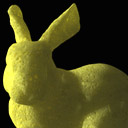
Modeling and Rendering of Quasi-Homogeneous Materials
Xin Tong, Jiaping Wang, Stephen Lin, Baining Guo and Heung-Yeung Shum
Many translucent materials consist of evenly-distributed heterogeneous elements
which produce a complex appearance under different lighting and viewing directions.
For these quasi-homogeneous materials, existing techniques
do not address how to acquire their material representations from physical samples
in a way that allows arbitrary geometry models to be rendered with these materials.
We propose a model for such materials that can be readily acquired from physical
samples. This material model can be applied to geometric models of arbitrary shapes,
and the resulting objects can be efficiently rendered without expensive subsurface
light transport simulation.
In developing a material model with these attributes, we capitalize on a key observation
about the subsurface scattering characteristics of quasi-homogeneous materials at
different scales. Locally, the non-uniformity of these materials leads to inhomogeneous
subsurface scattering. For subsurface scattering on a global scale, we show that
a lengthy photon path through an even distribution of heterogeneous elements statistically
resembles scattering in a homogeneous medium. This observation allows us to represent
and measure the global light transport within quasi-homogeneous materials as well
as the transfer of light into and out of a material volume through surface mesostructures.
We demonstrate our technique with results for several challenging materials that
exhibit sophisticated appearance features such as transmission of back illumination
through surface mesostructures.
Proceedings of ACM SIGGRAPH, Aug 2005. [ paper ] [ bibtex ]
ACM Transactions on Graphics, Volume24, Issue 3, July 2005.
|
|
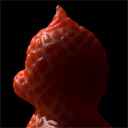
Shell Texture Functions
Xin Tong, Yanyun Chen,
Jiaping Wang,
Stephen Lin,
Baining Guo and
Heung-Yeung Shum
We propose a texture function for realistic modeling and efficient rendering of
materials that exhibit surface mesostructures, translucency and volumetric texture
variations. The appearance of such complex materials for dynamic lighting and viewing
directions is expensive to calculate and requires an impractical amount of storage
to precompute. To handle this problem, our method models an object as a shell layer,
formed by texture synthesis of a volumetric material sample, and a homogeneous inner
core. To facilitate computation of surface radiance from the shell layer, we introduce
the shell texture function (STF) which describes voxel
irradiance fields based on precomputed fine-level light interactions such as shadowing
by surface Mesostructures and scattering of photons inside the object. Together
with a diffusion approximation of homogeneous inner core radiance, the STF leads
to fast and detailed renderings of complex materials by raytracing.
Proceedings of ACM SIGGRAPH, Aug 2004. [ paper ] [ bibtex ]
ACM Transactions on Graphics Volume23, Issue 3, Aug 2004.
|
Toys in the Old Site
|

 )
)